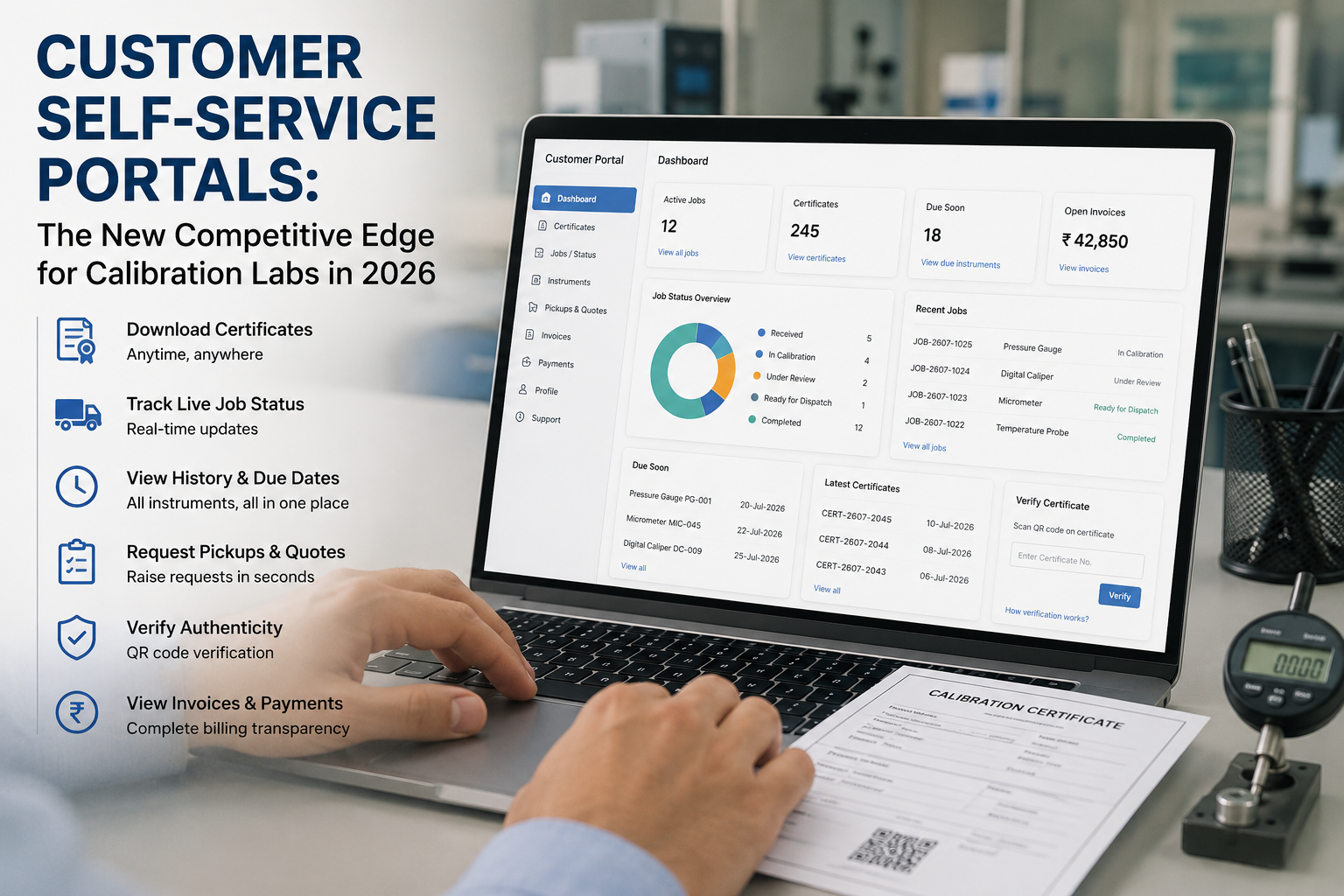
Ask a procurement manager at a mid-size manufacturer how they choose between two calibration labs with similar pricing and turnaround time, and increasingly the answer comes down to one thing: how easy it is to get a certificate when they need it. In 2026, a customer self-service portal is no longer a nice-to-have feature — it is becoming a deciding factor in who wins the contract.
This guide covers why customer portals have become a competitive advantage for calibration and testing labs, what a real portal should actually let clients do, and what your lab risks by not having one.
Why Customers Are Asking for This Now
Industrial clients in automotive, pharmaceutical, aerospace, and manufacturing manage dozens or hundreds of instruments across multiple vendors. They do not want to call each lab individually to check job status or chase down a certificate that was emailed to the wrong person three months ago. They expect the same self-service experience they get from every other modern B2B vendor — instant, anytime, no phone call required.
What a Real Customer Portal Should Let Clients Do
1 | Download Certificates Anytime: Every certificate ever issued to them, searchable and downloadable, without emailing your office. |
2 | Track Live Job Status: Real-time visibility into where their instrument is — received, under calibration, under review, or ready for dispatch — without a status-check phone call. |
3 | View Instrument History & Due Dates: A complete calibration history per instrument, plus a clear view of when each one is next due. |
4 | Request Pickups & Quotes: Raise a new calibration request or ask for a quote directly through the portal, instead of a back-and-forth email chain. |
5 | Verify Certificate Authenticity: Scan a QR code on any certificate to confirm it is genuine and unaltered — useful for their own customers and auditors. |
6 | View Invoices & Payment Status: A clear billing history, so accounts teams are not emailing your office for duplicate invoices. |
The Hidden Cost of Not Having One
|
Portal vs. Email: Why Email Doesn't Scale
Email-based delivery works fine for one certificate to one customer. It breaks down completely once a client has 20, 50, or 200 instruments across multiple sites — certificates get buried in inboxes, forwarded to the wrong person, or lost entirely when an employee leaves. A customer portal centralizes everything in one place that belongs to the customer's organization, not one employee's inbox — so nothing is ever lost when staff changes. |
How QuantumCals Customer Portal Works
|
Signs Your Lab Needs a Portal Now
- Your front desk or engineers spend real time each week answering "where is my certificate" calls.
- You have lost a renewal because a customer simply forgot their instrument was due.
- A prospective client has asked whether you offer online access before signing a contract.
- Your certificate delivery process is still one-by-one email attachments.
Conclusion
A customer self-service portal is no longer an add-on feature — it directly affects how many status calls your team fields, how much renewal business you capture, and increasingly, whether you win the contract at all.
See QuantumCals' customer portal in action — book a free 30-minute demo and we will show you exactly what your clients would see.