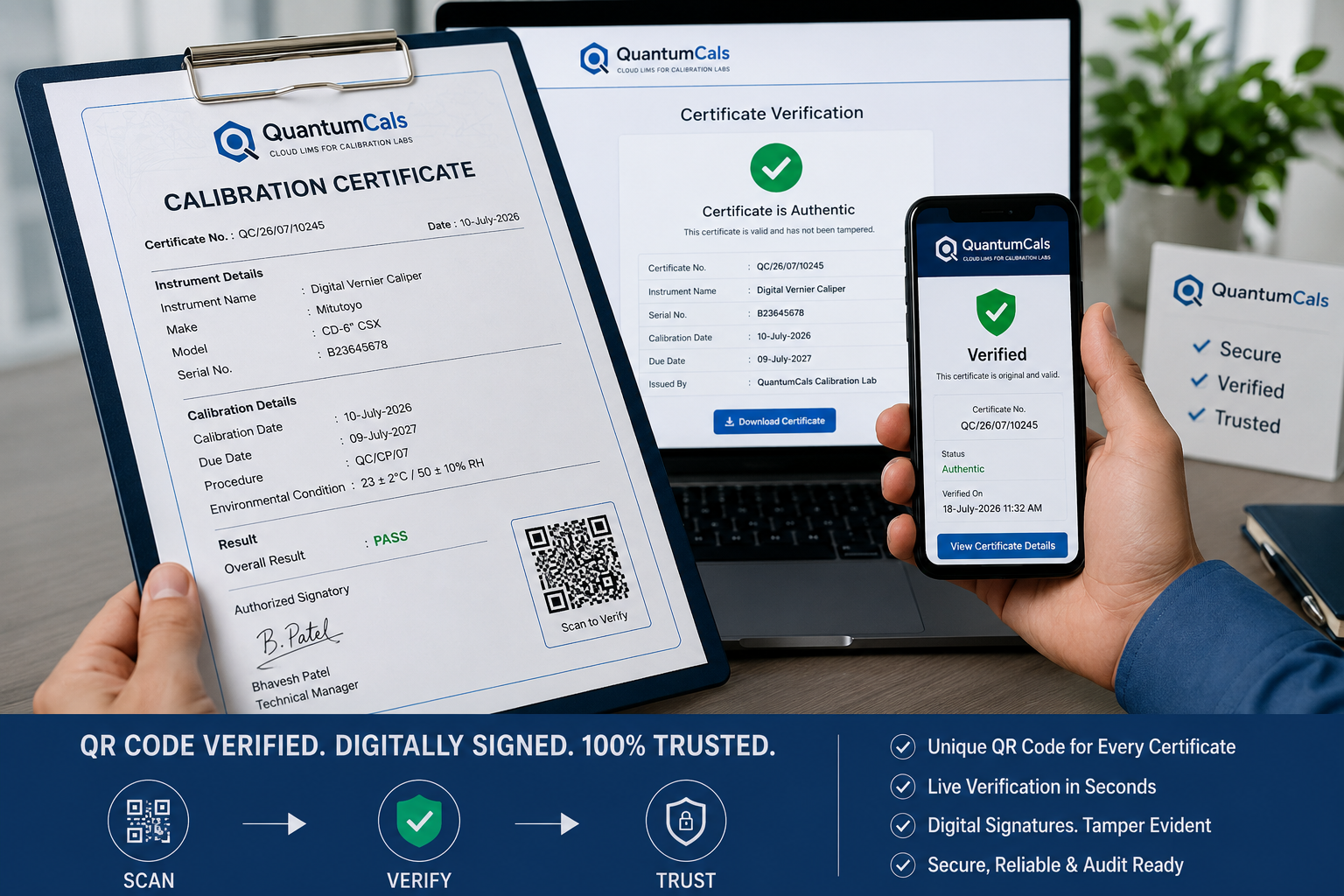
A calibration certificate carries real weight — it can be the deciding piece of evidence in a customer's own audit, a safety sign-off, or a compliance record filed away for years. That weight makes it a target. Altered readings, reused templates for equipment that was never actually recalibrated, and outright fabricated certificates are a real and growing problem across the calibration industry. QR code verification and digital signatures are how modern labs make their certificates provably authentic — not just professionally formatted.
How Calibration Certificate Fraud Actually Happens
|
Why Traditional PDF Certificates Are Easy to Tamper With
A standard PDF, even with a scanned signature and official logo, is just an image and text layer. Anyone with basic editing software can change a number, a date, or a name, and the file will look identical to the original. There is nothing in a plain PDF that lets a viewer independently confirm the document has not been altered since it was issued — the only way to know is to call the lab and ask, which most people never do. |
How QR Verification Makes a Certificate Provably Authentic
1 | Every certificate gets a unique QR code generated at the moment it is issued, tied to that specific certificate number and nothing else. |
2 | The QR code links to the live record on the lab's server — not to the PDF itself — so the source of truth cannot be edited by whoever is holding the file. |
3 | Any mismatch is flagged instantly. If a value in the PDF has been altered, it will not match the original record the QR code points to, and the discrepancy is immediately visible. |
4 | Anyone can verify in seconds, with just a phone camera — no phone call to the lab, no waiting for an email reply. |
Digital Signatures: The Second Layer of Protection
A scanned signature image pasted onto a template proves nothing — it can be copied onto any document by anyone who has the image file. A genuine digital signature, by contrast, is tied to a specific authorized signatory's account inside the LIMS, applied only through a role-based approval step, and becomes part of the certificate's tamper-evident record. If the certificate content changes after signing, the signature validation breaks — which is exactly the point.
What to Look for When You Receive a Calibration Certificate
- Does it have a QR code, and does scanning it lead to a live verification page — not just a copy of the same PDF?
- Does the verification page show the same values as the certificate in hand?
- Is the signature a genuine digital signature tied to an authorized signatory, not just a scanned image?
- Does the certificate number match the format the issuing lab normally uses?
How QuantumCals Protects Every Certificate
|
Conclusion
A calibration certificate is only as trustworthy as the system that generates and protects it. QR verification and genuine digital signatures turn a static PDF that anyone can edit into a document that can be independently verified in seconds, by anyone, at any time.
See how QuantumCals protects every certificate your lab issues — book a free 30-minute demo with our team.