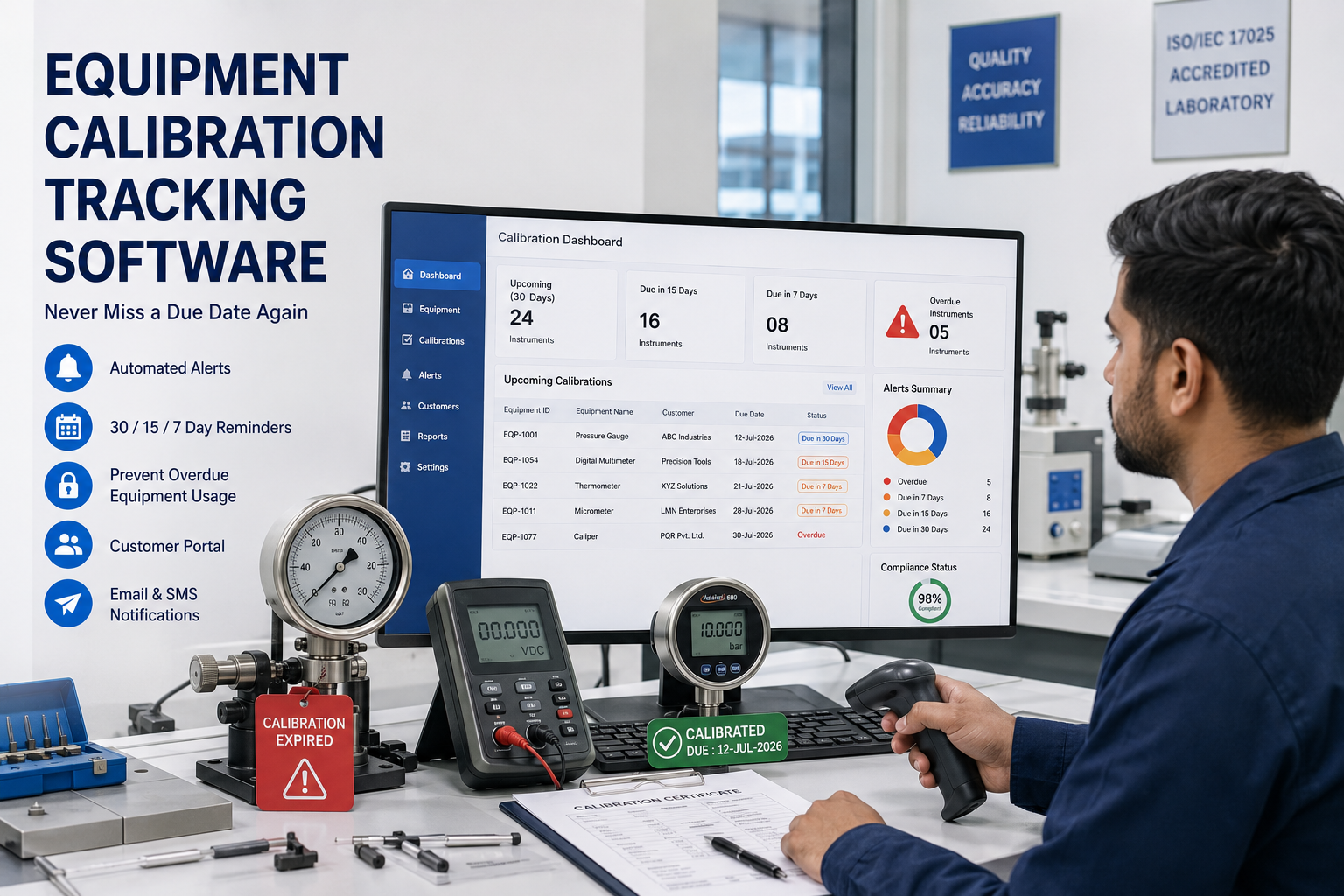
Ask any NABL assessor what the fastest way to fail a calibration lab audit is, and many will say the same thing: a certificate missing a required field. Not a wrong measurement — a missing traceability line, an absent uncertainty statement, or a certificate number that does not match the lab's own numbering scheme. Calibration certificate format is one of the most scrutinized — and most frequently mishandled — parts of running an accredited lab.
This guide breaks down exactly what an ISO 17025 and NABL compliant calibration certificate must contain in 2026, the formatting mistakes that trigger non-conformances, and how to make sure every certificate your lab issues passes assessment on the first look.
Why Certificate Format Is Not Just a Formality
A calibration certificate is a legal and technical record. It is the only document your customer, their auditors, and your own accreditation body will ever see from a given calibration job. If the format is inconsistent, incomplete, or non-compliant, it does not matter how accurate the underlying measurement was — the certificate itself becomes the non-conformance.
ISO/IEC 17025:2017 Clause 7.8 defines the minimum content requirements for calibration certificates, and NABL builds specific formatting expectations on top of this baseline. Missing or misplacing any required field is treated as a documentation non-conformance during assessment, regardless of how good the calibration work was.
The 8 Fields Every ISO 17025 / NABL Calibration Certificate Must Contain
1 | Laboratory Identification & Accreditation Details: Lab name and address, NABL accreditation number and logo (only where the parameter is within accredited scope), and reference to ISO/IEC 17025. |
2 | Unique Certificate Identification: A unique certificate number that cannot repeat, page numbering in the format Page X of Y, and the date of issue. |
3 | Customer & Instrument Identification: Customer name and address, instrument description, make, model, serial number, internal ID/tag number, and condition on receipt. |
4 | Date of Calibration & Environmental Conditions: The date the job was actually performed, plus ambient temperature and humidity where the parameter is environment-sensitive. |
5 | Method / Procedure Reference: The specific SOP, standard, or manufacturer procedure used to perform the calibration — never left blank or generic. |
6 | Measurement Results with Uncertainty: As-found and as-left readings, reference standard values, and the calculated uncertainty of measurement with its coverage factor stated. |
7 | Traceability Statement: A statement confirming results are traceable to SI units, naming the master standards used along with their certificate numbers and validity dates. |
8 | Authorization: The signature — physical or digital — name, and designation of the authorized signatory, along with the date the certificate was released. |
Certificate Format Mistakes That Trigger Non-Conformances
|
NABL vs. Generic ISO 17025 Certificates: What's Different
ISO/IEC 17025 defines the baseline minimum content every calibration certificate must contain, regardless of country or accreditation body. It focuses on what must be present. NABL adds India-specific formatting rules on top of that baseline — including precise logo placement, a mandatory statement separating accredited from non-accredited scope items on the same certificate, and a specific certificate numbering convention tied to the lab's accreditation certificate number. A certificate can satisfy ISO 17025 in content and still fail a NABL assessment on format alone. |
How QuantumCals Standardizes Certificate Format Automatically
Manually maintaining correct certificate format across every engineer, every parameter, and every accreditation body your lab serves is nearly impossible to do consistently by hand. QuantumCals builds format compliance directly into certificate generation:
|
Pre-Issue Certificate Checklist
- Does the certificate number follow the lab's documented, unique numbering convention?
- Is the uncertainty of measurement stated with its coverage factor and confidence level?
- Does the traceability statement name the specific master standard, its certificate number, and validity date?
- Are environmental conditions recorded for every parameter where they matter?
- Is the accreditation logo used only where the parameter is genuinely within scope?
- Has the certificate gone through the lab's documented review and approval workflow before release?
Conclusion
A calibration result can be perfectly accurate and still fail an audit if the certificate format around it is inconsistent or incomplete. Getting the format right, every time, for every parameter and every accreditation body your lab serves, is not realistic to manage by hand at scale.
Purpose-built LIMS software removes the risk by generating a compliant certificate automatically from job data, every time. If you want to see how QuantumCals keeps certificate format consistent across your entire lab, book a free 30-minute demo with our team.