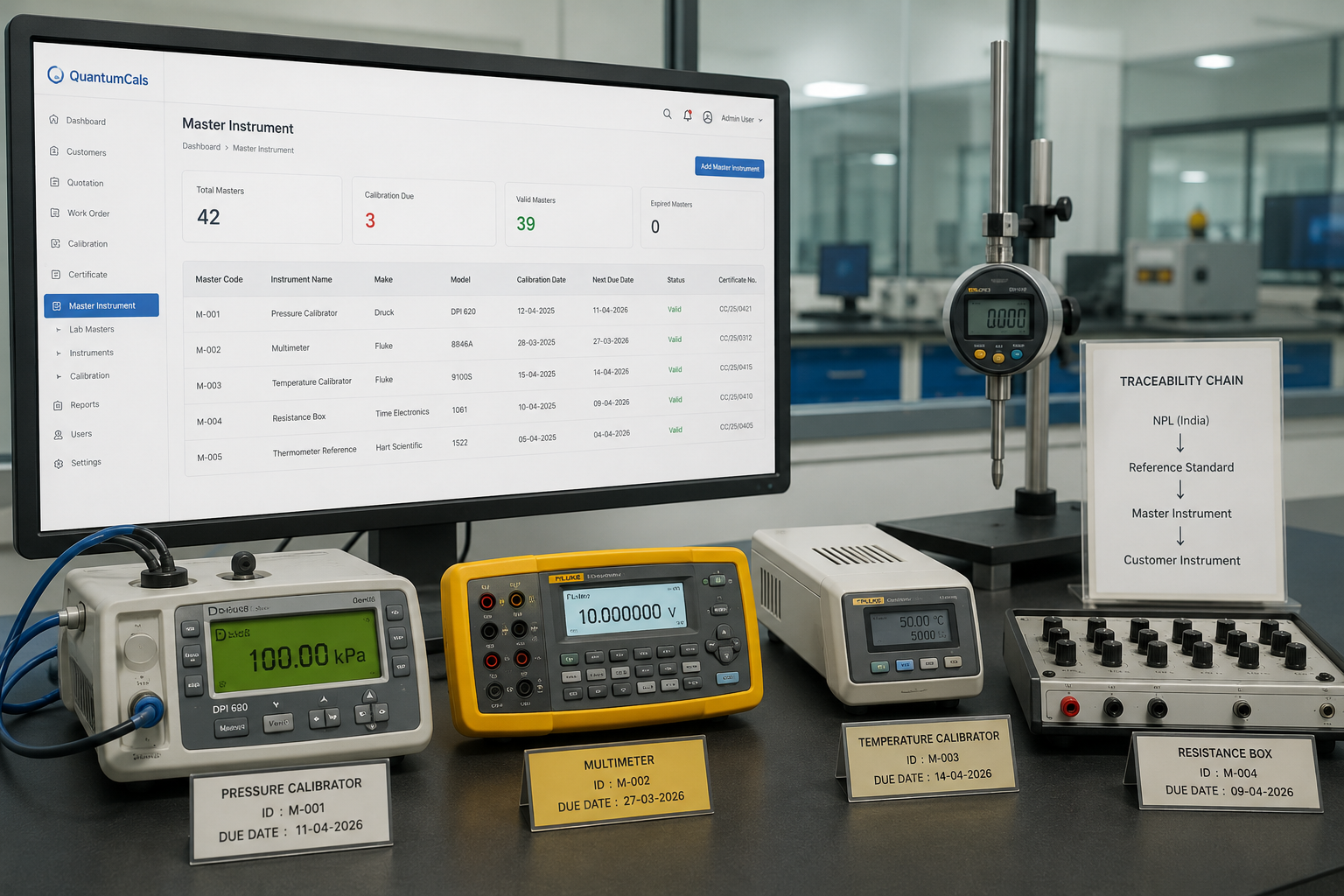
If your calibration laboratory has ever faced an assessment finding related to traceability, you know how costly a single gap can be. Master instrument traceability — the documented chain linking every calibration certificate your lab issues back to a national or international measurement standard — is not optional under ISO/IEC 17025 or NABL. It is a mandatory technical requirement, and assessors check it on every visit.
Yet it remains one of the most common sources of non-conformances in calibration lab audits. This guide explains what master instrument traceability actually means, why most labs struggle with it manually, and how modern LIMS software eliminates the gap entirely.
What Is Master Instrument Traceability?
Master instrument traceability is the documented, unbroken chain of calibrations that connects your reference standards and master instruments back to a national measurement institute (NMI) — such as NPL in India, NIST in the United States, or PTB in Germany — or to an internationally recognized standard.
In practical terms, it means that when your lab issues a calibration certificate for a customer's pressure gauge, you must be able to document that:
| 1 | The master pressure standard your engineer used during calibration is itself calibrated and traceable to NPL or an equivalent NMI. |
| 2 | That master standard's calibration certificate is current — it has not expired at the time the customer job was performed. |
| 3 | The certificate number and uncertainty of the master standard used is recorded on or linked to the customer's calibration certificate. |
This three-level chain — customer instrument → your master standard → national standard — is what ISO 17025 clause 6.5 (metrological traceability) requires. NABL assessors verify it on every laboratory assessment. Fail any link in this chain, and you have a nonconformity.
Why Master Instrument Traceability Is Hard to Manage Manually
The traceability chain sounds straightforward in theory. In practice, calibration labs managing it manually face serious operational challenges.
|
What NABL and ISO 17025 Actually Require
ISO/IEC 17025:2017 Clause 6.5 states that measurement results must be traceable to the International System of Units (SI), through an unbroken chain of calibrations. Each calibration in the chain must contribute to the uncertainty of the measurement.
NABL's technical requirements build on this. For Indian calibration labs, NABL expects:
- All reference standards and master instruments to be calibrated by a NABL-accredited laboratory or an NMI.
- The calibration certificates of all reference standards to be valid and current at the time of use.
- Every calibration certificate issued by the lab to include or reference the master instruments used — including their certificate numbers and validity dates.
- A system in place to prevent the use of expired or uncalibrated reference standards.
The last point is critical. NABL requires a system — not just a spreadsheet, not just a reminder in someone's phone. Assessors look for documented evidence that your lab has a systematic process that prevents expired masters from being used in live calibration jobs.
The Cost of Getting Traceability Wrong
Non-conformances related to master instrument traceability are not minor paperwork issues. They can have serious consequences:
|
How Modern LIMS Software Automates Master Instrument Traceability
The right Laboratory Information Management System (LIMS) eliminates every manual traceability failure point by making the traceability chain part of the calibration job workflow itself — not an afterthought.
Here is how a purpose-built LIMS like QuantumCals handles it:
1 | Master Instrument Registry: Every reference standard and master instrument is registered in the system with its calibration certificate number, calibration date, valid-until date, calibrating authority, and measurement uncertainty. This is the single source of truth for all traceability data. |
2 | Automatic Expiry Alerts: The system monitors every master instrument's due date and sends alerts at 30, 15, and 7 days before expiry — to the lab manager, quality officer, or any role you configure. No master slips through unnoticed. |
3 | Compliance Block on Expired Standards: This is the key safeguard. When an engineer tries to assign an expired master instrument to a calibration job, the system blocks it — with a clear error message and the correct alternative. No calibration can proceed on an expired master. |
4 | Job-to-Master Linking: Every calibration job is linked to the specific master instrument(s) used at the time of calibration. The master's certificate number, validity date, and uncertainty are automatically captured on the job record — and appear on the generated customer certificate. |
5 | Instant Traceability Audit Trail: Any audit query about which master was used for which job on which date is answered in seconds. The system shows a complete, timestamped traceability chain for every certificate ever issued — including the status of the master instrument at the time the job was performed. |
Master Instrument Traceability vs. Customer Instrument Traceability
One important distinction that labs sometimes confuse:
Master instrument traceability refers to the calibration status and traceability chain of your lab's own reference standards — the instruments your engineers use to perform calibrations. These must be calibrated by an external NABL lab or NMI and kept current. Customer instrument traceability refers to the traceability statement on the certificates you issue to customers — showing that the calibration of their instrument is traceable to national standards through your calibrated masters. This is what appears on the certificate itself. |
Both are required. A complete LIMS platform manages both — tracking the traceability of your masters internally, and automatically building the traceability statement on every outgoing customer certificate.
Building a Traceability-Ready Lab with QuantumCals
QuantumCals is purpose-built for calibration and testing laboratories operating under NABL, ISO 17025, FDAS, IQAS, and ACCAB. Its Master Instrument Sync module gives your lab a complete, automated traceability management system:
|
Before Your Next NABL Assessment
If your lab's next NABL assessment is approaching, traceability readiness should be at the top of your preparation list. Run through this quick check:
- Can you instantly list all reference standards currently in use and their valid-until dates?
- Can you show, for any certificate issued in the last 12 months, which master instrument was used and confirm it was valid on that date?
- Is there a documented system that prevents expired masters from being used — not just a policy, but an enforced technical control?
- Are uncertainty contributions from your masters propagated to your customer certificates?
If any of these are a manual process or a spreadsheet lookup, that is your risk. An assessor asking these questions during the technical assessment expects to see system-enforced controls, not Excel files.
Conclusion
Master instrument traceability is the backbone of every calibration certificate your lab issues. Without a systematic approach to managing reference standard due dates, job-to-master linking, and automated compliance blocks, your lab is one busy week away from an expired master finding its way into a live calibration job — and a major nonconformity at your next assessment.
Modern LIMS software removes this risk entirely by building traceability management into the calibration workflow — not as a separate task, but as an automatic part of every job created in the system.
If you would like to see how QuantumCals manages master instrument traceability for NABL and ISO 17025 labs, book a free 30-minute demo with our team. No commitment, no sales pressure — just a live walkthrough of the complete traceability module in your lab's context.