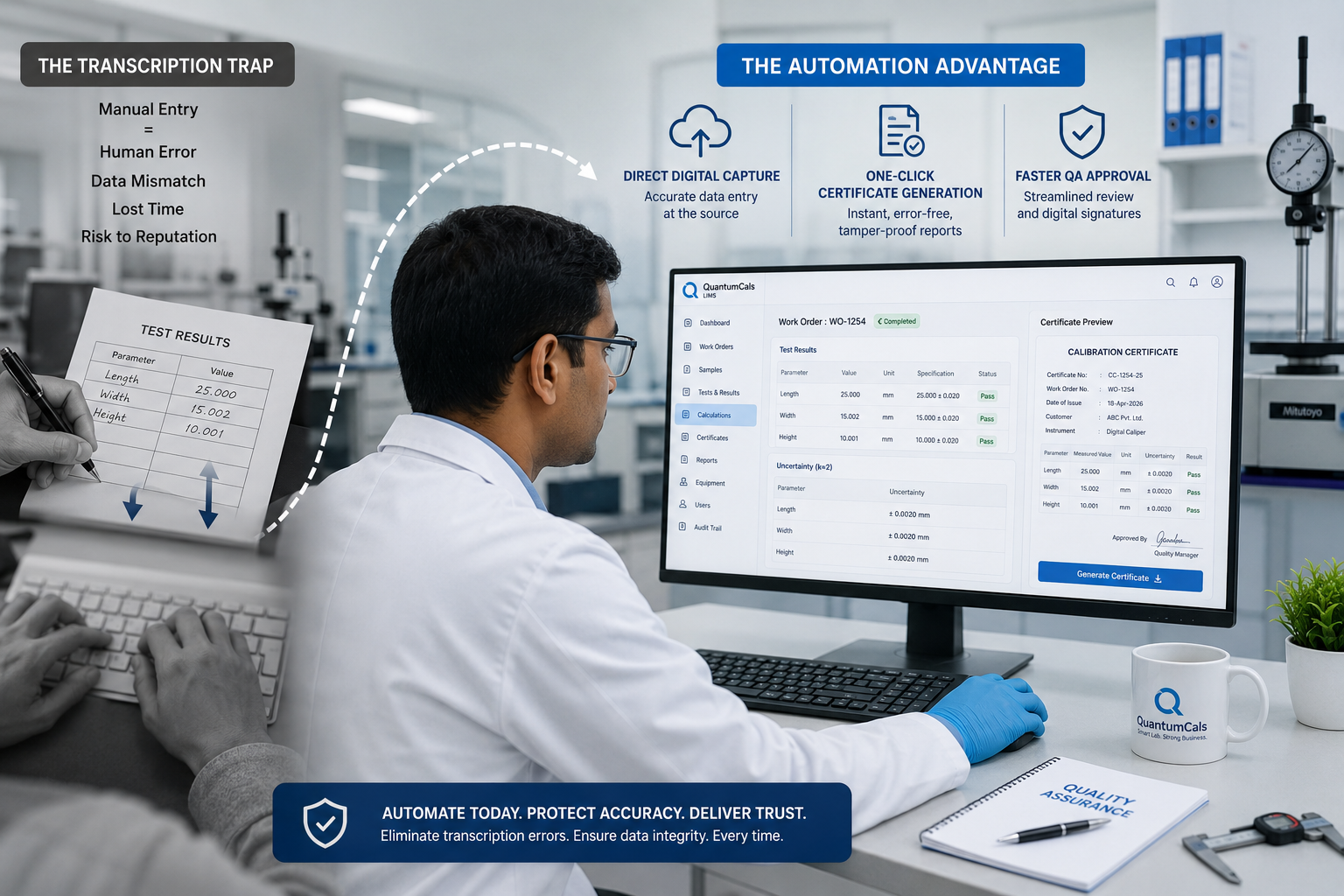
When your laboratory technicians finish a complex test, they capture highly precise raw metrics. But what happens next? In many traditional calibration labs, those numbers are written on paper worksheets and handed off to a desk clerk to be manually re-typed into a Word template or standard Excel sheet.
This step introduces the "Transcription Trap"—the quiet, highly frequent window where human error risks your lab's entire reputation. A single misplaced decimal point or a mistyped component ID can instantly invalidate a calibration run, forcing expensive rework or worse, exposing your clients to operational failures.
By shifting to an automated data workflow, modern testing environments eliminate this liability completely. Here is how moving toward automated processes safeguards your data structure.
1. Direct Digital Capture
Instead of relying on a multi-step paper trail, a cloud-based LIMS allows your engineers to input test calculations directly into the application layer. Data is verified instantly against pre-configured equipment tolerances, highlighting outliers immediately before a report is even queued.
2. Single-Click Certificate Generation
Why spend 20 minutes copying data into a desktop document template when your system can map it instantly? Automated certificate generation pulls calculated values directly from the work order database. It populates custom layout formats, calculates master uncertainties, and generates signed, tamper-proof PDFs in seconds.
3. Accelerated QA Turnaround Time
When data handling drops its manual dependencies, the quality review queue shrinks. Quality managers can access a unified dashboard to review raw values alongside system-generated outputs. Approvals happen instantly via digital signatures, getting certified equipment back to your clients days faster than conventional methods.
Protect Your Core Analytics
Accuracy isn't just about how your technicians use their master instruments; it is about how safely your data flows from the bench to the final page. Elevate your operational standards by deploying automated, paperless workflows that make data transcription errors a thing of the past.