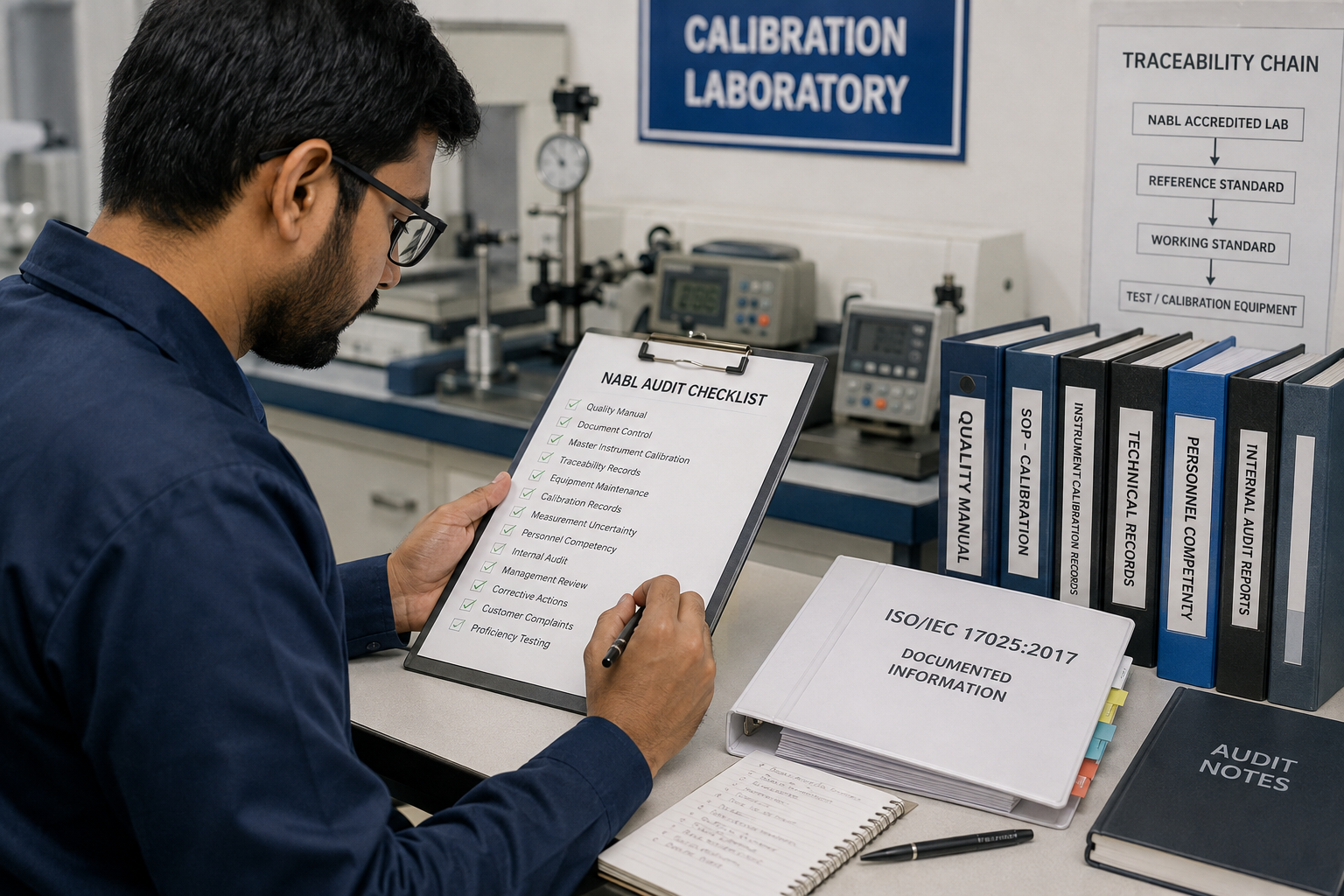
A NABL surveillance or re-assessment visit gives your assessors a limited window to judge whether your laboratory is genuinely operating to ISO/IEC 17025 standards — or just appearing to. The labs that fail almost always fail on the same dozen issues, none of which require expensive equipment to fix. They require documentation, discipline, and a system that keeps evidence up to date automatically.
This checklist is structured around the five areas NABL assessors examine most closely during a calibration laboratory audit in India.
1. Quality Management System Documentation
The Quality Manual is the first document an assessor picks up. It must reflect how the lab actually operates — not how it operated three years ago when the manual was last revised.
- Quality Manual version dated within the last 12 months
- Scope of accreditation matches the current NABL certificate
- All procedures referenced in the manual are present and accessible
- Document control log shows revision history for each procedure
- Personnel have read and signed acknowledgement of relevant procedures
A common failure point: procedure documents that reference equipment no longer in the lab, or reference staff members who have left. A LIMS with document control timestamps every revision and flags stale references automatically.
2. Master Instrument Traceability Records
Every master or reference instrument used in calibration must carry an unbroken metrological traceability chain back to national standards. Assessors will pick instruments at random and trace their calibration certificates backwards.
- Current valid calibration certificate for each master instrument
- Certificate issued by a NABL-accredited laboratory (or NPL/NMI for primary standards)
- Uncertainty stated at coverage factor k=2
- Next due date clearly recorded and not exceeded
- Out-of-service instruments physically tagged and removed from the calibration area
- Calibration history available for at least the last two calibration cycles
If even one master instrument has an expired certificate and was used for customer calibrations after that date, those certificates may need to be recalled. A master instrument management system with automatic due-date alerts prevents this entirely.
3. Technical Records and Calibration Data
Assessors will pull a sample of calibration records — both current and historical — and verify that the raw measurement data supports the certificate values. This is where many labs are caught off guard.
- Original observation sheets retained (not just the final certificate)
- Measurement uncertainty calculation documented for each parameter
- Environmental conditions (temperature, humidity) recorded at time of calibration
- Equipment used for each job cross-referenced to its calibration status
- Correction factors applied are traceable to the current certificate
- Authorized signatory on certificate matches the list of approved personnel
4. Personnel Competency Records
Clause 6.2 of ISO/IEC 17025:2017 requires that all personnel performing calibrations are demonstrably competent. “Competent” means documented training, evaluation, and authorization — not just years of experience.
- Job descriptions defining required competencies for each role
- Training records with dates, content, and trainer sign-off
- Internal competency evaluation records (not just certificates from external courses)
- Authorization matrix showing which technician is approved for which parameters
- Records of participation in proficiency testing or inter-laboratory comparisons
5. Internal Audit and Management Review
A laboratory that cannot show a completed internal audit within the last 12 months, with corrective actions closed out, will almost always receive a non-conformance on the spot.
- Internal audit schedule covering all clauses of ISO/IEC 17025:2017
- Audit reports with findings, root cause analysis, and corrective actions
- Evidence of corrective action closure (not just a plan — actual evidence of implementation)
- Management review minutes from the last 12 months
- Customer complaint register and outcome records
- Proficiency testing results and any follow-up actions
The Three Weeks Before Your Audit
Run a mock audit using this checklist three weeks before the actual assessment. Any gap you find with three weeks to spare can be fixed. Any gap an assessor finds on the day becomes a non-conformance that triggers a follow-up visit.
The labs that consistently pass NABL audits without findings are not necessarily better equipped than those that fail — they are better organized. Their records are current, their instruments are within validity, and their technicians can explain what they do and why without reaching for a manual. A laboratory management system that maintains these records in real time makes that standard of organization the default, not the exception.