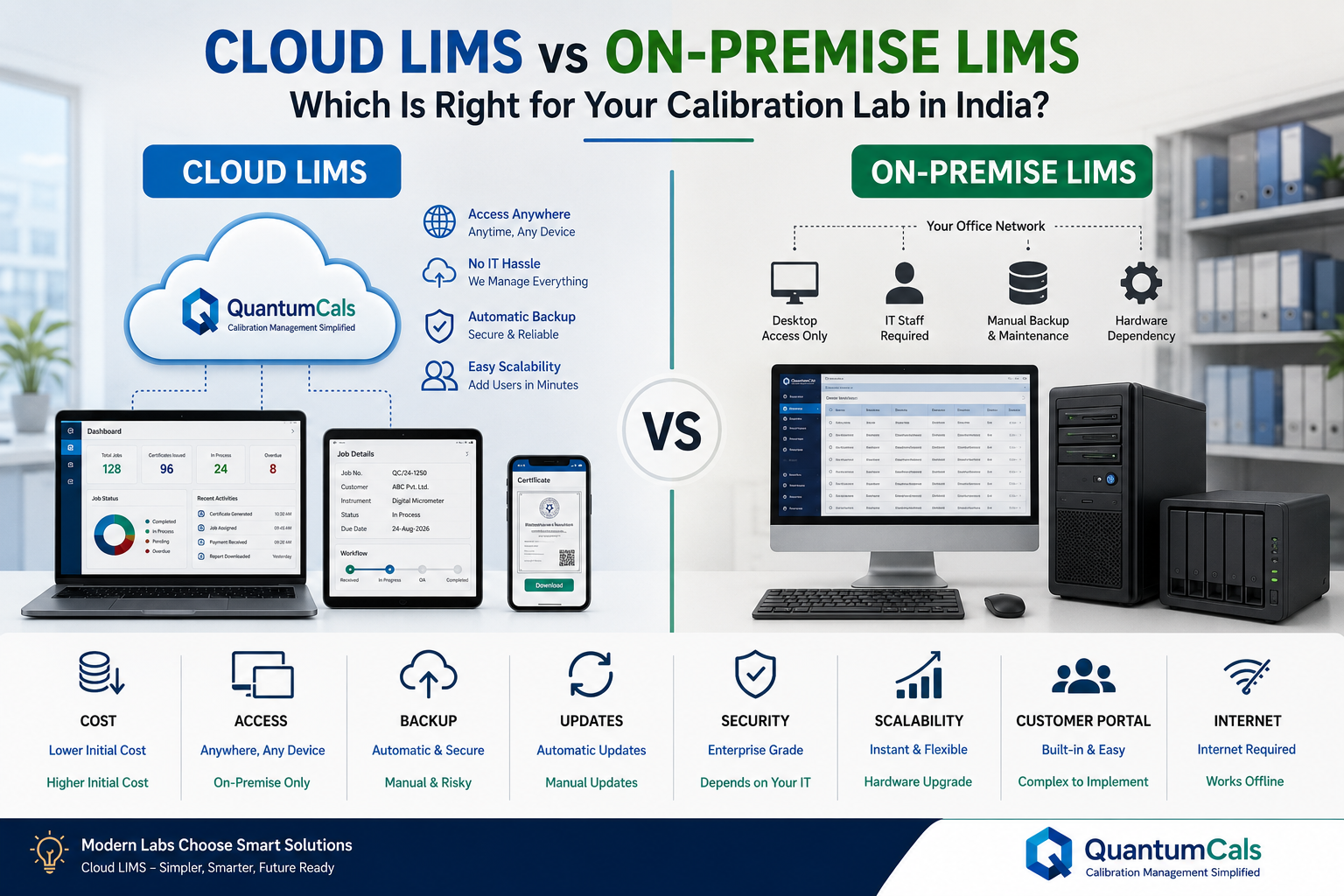
When labs start evaluating laboratory information management software, the cloud-versus-on-premise question comes up early and often derails the conversation. The decision sounds technical, but it mostly comes down to three practical questions: who manages the servers, where does your data live, and what happens when something breaks?
Here is a clear comparison for Indian calibration and testing laboratories evaluating both options in 2026.
What Cloud LIMS and On-Premise LIMS Actually Mean
A cloud LIMS (also called SaaS LIMS) runs on servers owned and maintained by the software vendor. You access it through a browser — no installation, no server room, no IT department required. Your data is backed up automatically and the software is updated without your involvement.
An on-premise LIMS is installed on servers that your lab owns and manages. You control the hardware, the backups, and the update schedule. You also bear the cost and responsibility of maintaining the infrastructure.
Side-by-Side Comparison
| Factor | Cloud LIMS | On-Premise LIMS |
|---|---|---|
| Initial Cost | Low — monthly or annual subscription | High — server hardware + license fee |
| IT Requirement | None — vendor manages everything | In-house IT staff or outsourced support needed |
| Data Access | Anywhere — browser, mobile, remote | Only on-site unless VPN is set up |
| Backup and Recovery | Automatic — vendor responsibility | Manual — your responsibility |
| Uptime | Depends on internet connection quality | Works offline — no internet dependency |
| Updates | Automatic — always latest version | Manual — you control the schedule |
| Data Ownership | Your data, vendor servers | Your data, your servers |
| Scalability | Instant — add users in minutes | Requires hardware upgrade |
| Customer Portal | Built-in — customers access via web | Complex to expose to external users |
The Case for Cloud LIMS in India
The vast majority of Indian calibration laboratories — particularly those with fewer than 50 employees — are better served by a cloud-based LIMS for three practical reasons.
First, reliable IT infrastructure is expensive to maintain in India outside of large metro areas. A cloud LIMS eliminates the need for a server room, an IT administrator, and a disaster recovery plan. The vendor handles all of this, usually with data centres that offer 99.9% uptime SLAs.
Second, cloud platforms enable the customer-facing features that are increasingly expected by industrial customers: online certificate download portals, real-time job status, and digital signature verification. These features are architecturally straightforward on the cloud and complex to build on an on-premise installation.
Third, NABL and ISO/IEC 17025 do not require data to be stored on-premise. The standard requires that records are controlled, retrievable, and protected — all of which a reputable cloud vendor provides with stronger guarantees than most labs can achieve with internal infrastructure.
When On-Premise Still Makes Sense
On-premise LIMS remains appropriate in a narrow set of scenarios: defence or government laboratories with classified data handling requirements, very large laboratories with existing enterprise IT infrastructure and a dedicated DBA team, or organizations that have already invested heavily in on-premise ERP systems and need tight integration. For most commercial calibration and testing labs, these conditions do not apply.
The Practical Answer
If your lab has a reliable internet connection and does not operate in a classified or highly restricted data environment, a cloud LIMS will cost less to implement, require less maintenance, and give your customers a better experience than an on-premise alternative. The question is not really cloud versus on-premise — it is which cloud vendor you can trust with your operational data and your customer relationships.
Look for a vendor that stores data in Indian data centres, can provide an uptime SLA in writing, and allows you to export your full dataset at any time without a fee. Those three requirements filter out most of the risk.