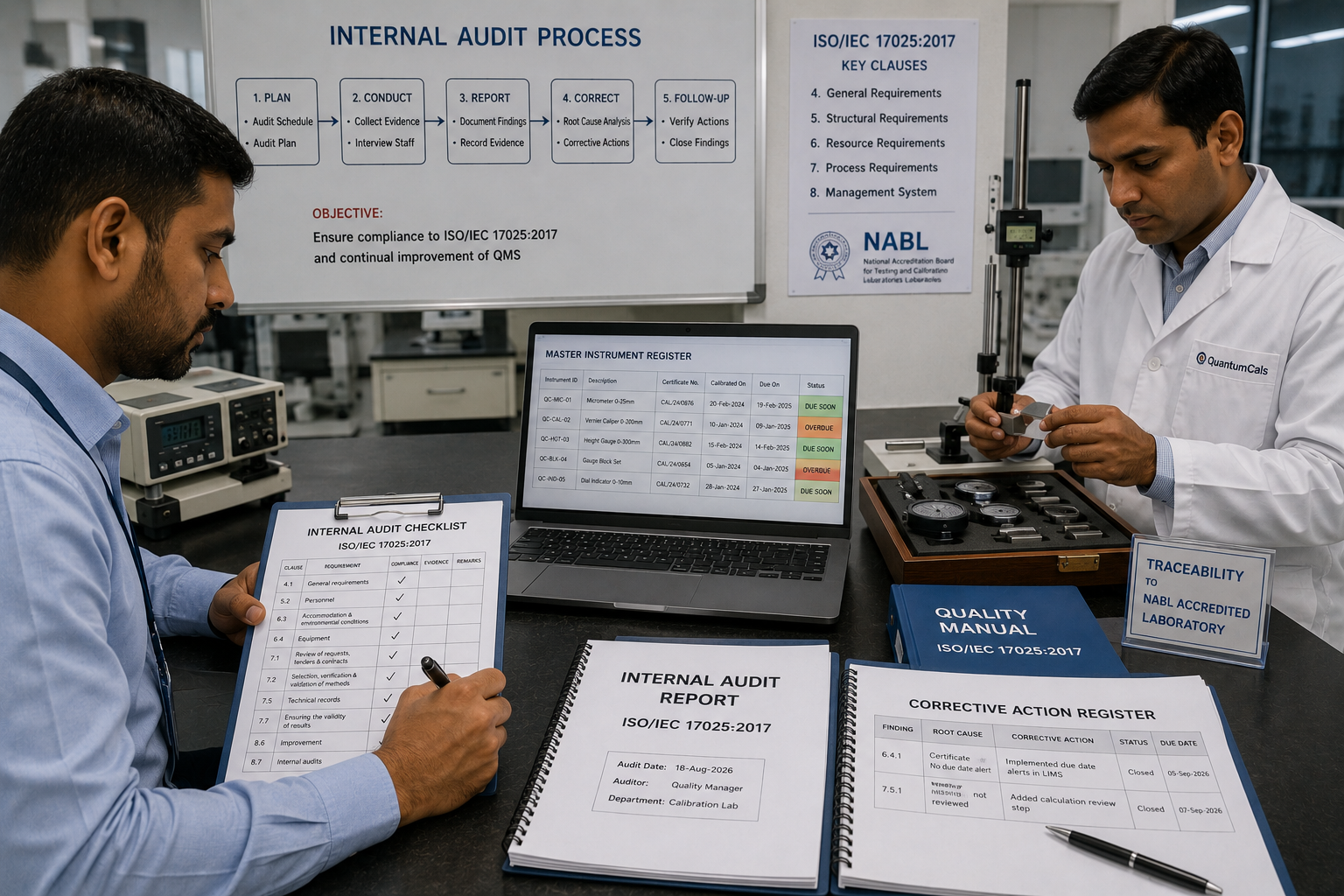
Clause 8.7 of ISO/IEC 17025:2017 requires that laboratories conduct internal audits at planned intervals to provide information on whether the quality management system conforms to the standard and the laboratory's own requirements, and is effectively implemented and maintained. NABL assessors expect to see a completed internal audit within the last 12 months — and they expect to see corrective actions closed, not just planned.
Many labs treat the internal audit as a compliance exercise: a checklist ticked, a report signed, filed and forgotten. Assessors can tell when this has happened. An internal audit that actually improves your laboratory looks different from one that exists to satisfy a requirement.
Planning the Internal Audit
The internal audit must cover all elements of the QMS, but it does not need to cover all elements in a single session. Most labs break the audit into sections across the year — technical requirements in one quarter, support processes in another — as long as every clause is covered within the 12-month cycle.
Before the audit, the lead auditor (who must be independent of the area being audited) should prepare: an audit schedule showing which clauses will be covered and on which date, an audit plan distributed to relevant personnel at least one week in advance, an evidence checklist for each clause based on what objective evidence would confirm compliance, and the previous internal audit report and any open corrective actions from it.
Conducting the Audit: Clause by Clause Focus Areas
The following clauses receive the most scrutiny from NABL assessors and therefore deserve the deepest attention in your internal audit.
Clause 6.2 — Personnel: Verify that authorization records exist for every technician performing calibrations. Pull the authorization matrix and cross-check it against recent calibration records. If a technician performed a calibration for a parameter they are not authorized for, that is a finding.
Clause 6.4 — Equipment: Check the master instrument register. For each instrument, verify the current calibration certificate is within validity, the next due date is recorded, and the uncertainty on the certificate is appropriate for the calibrations performed using that instrument. Out-of-date instruments still marked as in service in the register are a frequent source of non-conformances.
Clause 7.5 — Technical Records: Select five calibration records at random — mix of recent and older. For each, verify that the original observation sheet is present, environmental conditions are recorded, the instrument used is traceable to the certificate, and the uncertainty stated on the final certificate is consistent with the calculation in the record. Any discrepancy is a finding.
Clause 7.7 — Ensuring Validity of Results: Review your proficiency testing participation records. ISO/IEC 17025 requires laboratories to monitor their performance through proficiency testing or inter-laboratory comparisons. If you have not participated in any PT scheme in the last 12 months for your accredited parameters, this is a significant gap.
Clause 8.6 — Corrective Actions: Pull all corrective action records from the previous 12 months. For each one, verify that the root cause was identified (not just the symptom), the corrective action addressed the root cause (not just the immediate issue), and objective evidence of implementation is on file. A corrective action plan with no implementation evidence is not a closed corrective action.
Writing the Internal Audit Report
The audit report is the document that NABL assessors will read. It must include: audit scope, criteria, and date; auditor name and independence declaration; processes and clauses audited; findings categorized as non-conformances, observations, or opportunities for improvement; for each finding the clause reference, objective evidence found, and the statement of the finding; corrective action requests issued with due dates; and audit conclusion.
Avoid vague finding statements like records need improvement. Write findings as: Clause 6.4.1 — The calibration certificate for master micrometer QC-MSG-001 expired on 19-June-2024. The instrument was used for customer calibrations on 15 subsequent occasions after this date without a valid certificate. Evidence: job records J2024-156 through J2024-171.
Closing Corrective Actions
Every finding must have a corrective action with a root cause analysis. The root cause is rarely human error — that is a symptom. The root cause is usually a system gap: no reminder system for due dates, no verification step in the job acceptance procedure, no cross-reference check between the instrument register and the job record system.
Corrective actions must be closed with objective evidence: a screenshot of the new reminder system, a revised procedure with the verification step added, training records showing the new process was communicated to all staff.
A laboratory information management system can transform your internal audit from a paperwork exercise into a genuine quality tool. When instrument due dates are tracked automatically, technical records are generated from calibration data rather than typed manually, and job status is visible in real time, the internal audit findings shift from systemic failures to minor optimisations — exactly what a mature quality system looks like to a NABL assessor.