If you manage a calibration or testing laboratory, you have probably searched for calibration software and come back with a confusing mix of results — from enterprise ERP systems to generic job trackers that barely understand what a calibration certificate is.
This guide cuts through the confusion. We explain exactly what calibration software is, how it differs from testing software, what features actually matter in 2026, and what to look for before you sign up for anything.
What is Calibration Software?
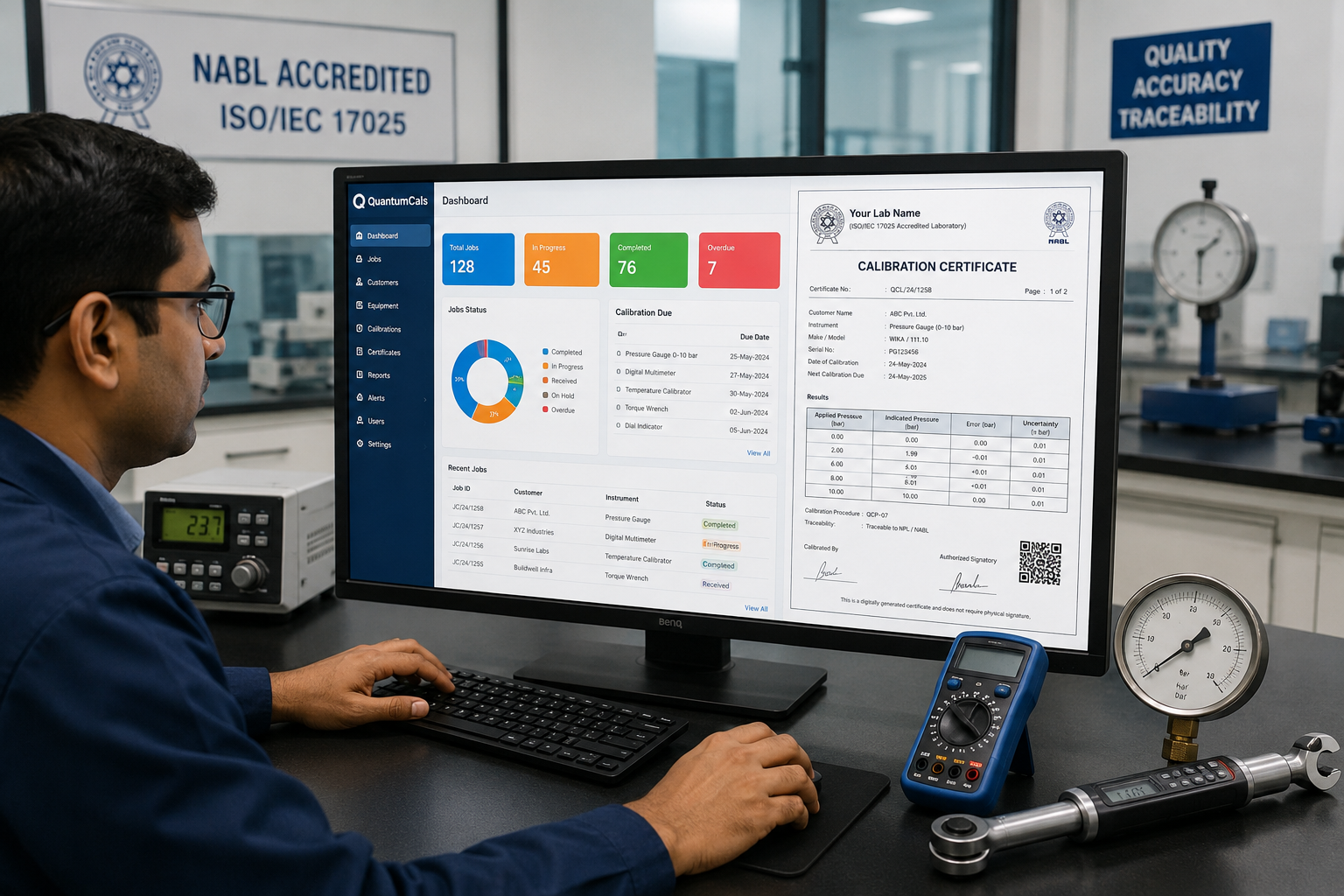
Calibration software is a specialized digital platform designed to manage the complete workflow of a calibration laboratory. It replaces paper job sheets, manual certificate templates, and scattered Excel records with a single organized system that tracks every instrument, job, and certificate from start to finish.
At its core, good calibration software does four things:
| 1 | Job Management: Creates job sheets for incoming instruments, assigns engineers, tracks progress, and records calibration results — all in one place. |
| 2 | Certificate Generation: Automatically generates accreditation-compliant calibration certificates — with digital signatures, QR codes, and uncertainty values — directly from the job data. No manual copy-pasting. |
| 3 | Equipment Tracking: Maintains a master register of all instruments and reference standards, tracks calibration due dates, and sends automated alerts before expiry. |
| 4 | Compliance Management: Maintains a complete, immutable audit trail of every action in the system — mandatory for labs accredited under ISO 17025, NABL, FDAS, IQAS, or ACCAB. |
How is Calibration Software Different from Testing Software?
The terms are often used together because many labs operate as both — but there is a clear distinction:
Calibration software is built around instrument calibration workflows — jobs where a physical instrument (pressure gauge, thermometer, torque wrench, etc.) is measured against a reference standard to determine its accuracy. The output is a calibration certificate with measurement data, uncertainty, and traceability to national standards. Testing software manages laboratory workflows where physical samples — materials, chemicals, products, food items — are tested against defined specifications. The output is a test report or test certificate containing pass/fail results, measured values, and method references. |
The best modern LIMS platforms — like QuantumCals — support both calibration and testing workflows from one platform, so labs that do both don't have to manage two separate systems.
Who Needs Calibration Software?
You need dedicated calibration software if your lab:
- Issues calibration certificates to external customers
- Is accredited under ISO 17025, NABL, FDAS, IQAS, or ACCAB
- Manages 10 or more active instruments internally
- Has more than 2 calibration engineers
- Is preparing for a first-time accreditation assessment
- Has failed or nearly failed an audit due to documentation issues
If any of these apply to your lab, a purpose-built calibration software platform — not a generic ERP or job tracker — is the right investment.
7 Features Every Calibration Software Must Have in 2026
1 | Automated Certificate Generation with QR Verification: Your calibration software should generate certificates in seconds — not minutes — with digital signatures, measurement data, and a QR code that lets customers verify authenticity instantly. Manual certificate filling is a liability, not a workflow. |
2 | Multi-Accreditation Support: A single lab often serves customers under multiple accreditation bodies. Your calibration software must support ISO 17025, NABL, FDAS, IQAS, and ACCAB from one interface — not require separate systems or templates per body. |
3 | Equipment Due-Date Alerts: Every reference standard and master instrument in your lab has a calibration due date. Your calibration software must track this automatically and alert you — and optionally your customer — before expiry. Operating with an expired master is a critical non-conformance. |
4 | Immutable Audit Trail: Every data entry, approval, and certificate release must be logged with a timestamp and user ID — and cannot be edited or deleted. This is a hard requirement under ISO 17025 and NABL. If your current calibration software allows editing old records without a log, that is an audit risk. |
5 | Customer Self-Service Portal: Top calibration software platforms give your customers a branded portal to download certificates, track live job status, and view instrument history — without calling your lab. This alone eliminates dozens of inbound calls per week. |
6 | Cloud-Based Access: In 2026, any calibration software that requires a local server is already outdated. Cloud-based calibration software means your lab manager can check job status from their phone, engineers update job sheets from the lab floor, and your data is automatically backed up — no IT department required. |
7 | Integrated Billing: The best calibration software ties billing directly to completed jobs — automatically generating invoices from calibration job data. This eliminates a second round of manual data entry and ensures no completed job goes unbilled. |
Common Mistakes When Evaluating Calibration Software
|
QuantumCals: Calibration Software and Testing Software in One Platform
QuantumCals is purpose-built calibration software and testing software for accredited laboratories. It is cloud-based, requires no installation, and most labs are fully operational within 12 minutes of signing up.
It supports ISO 17025, NABL, FDAS, IQAS, and ACCAB natively — with built-in certificate templates, QR-verifiable digital certificates, multi-level approvals, automated equipment alerts, a customer self-service portal, and complete audit trails. Everything your lab needs in one platform, with no customization required for standard calibration and testing workflows.
If you are evaluating calibration software for your lab in 2026 — book a free 30-minute demo with the QuantumCals team. No commitment, no pressure. See the complete platform live and decide if it is the right fit for your lab.